The Tessera Guide
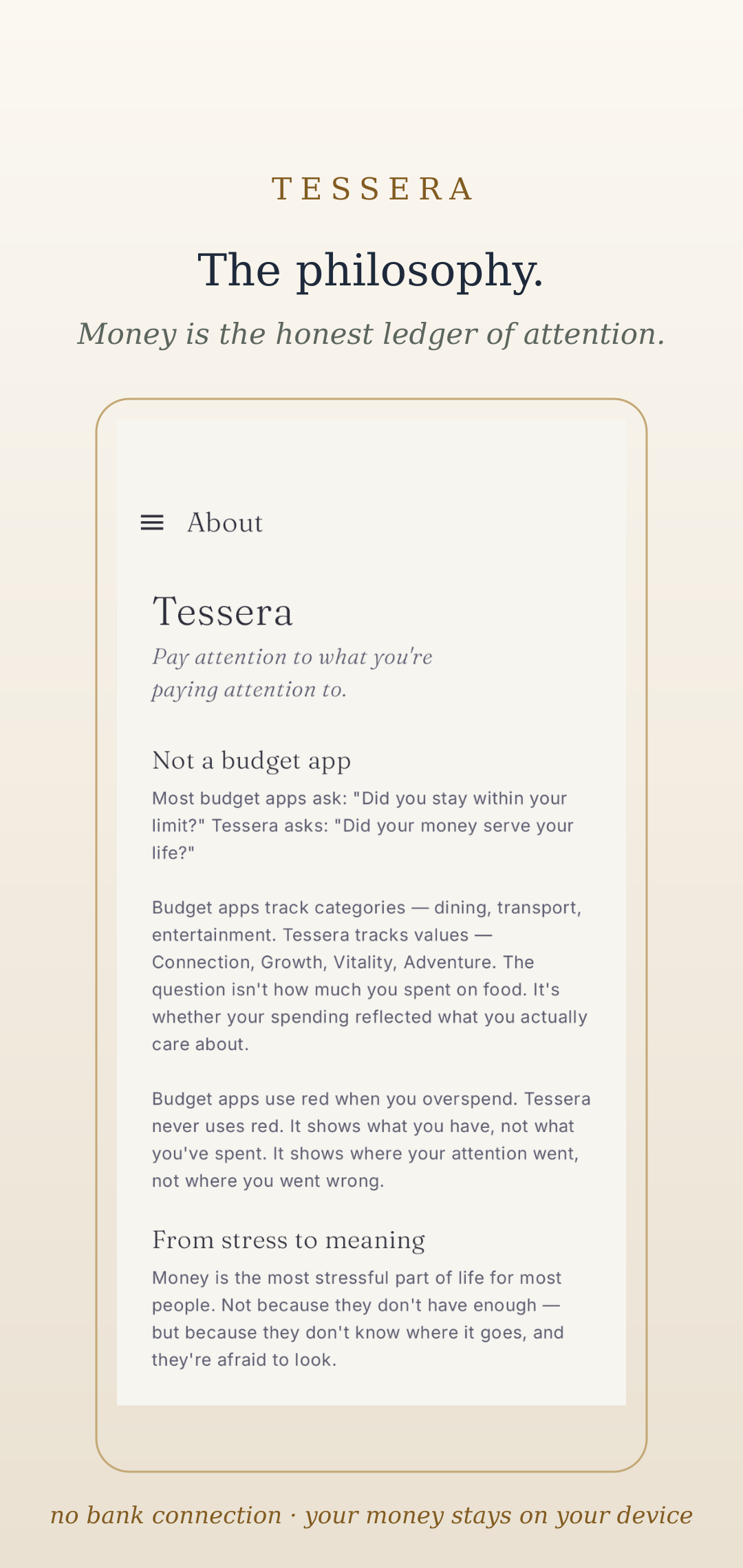
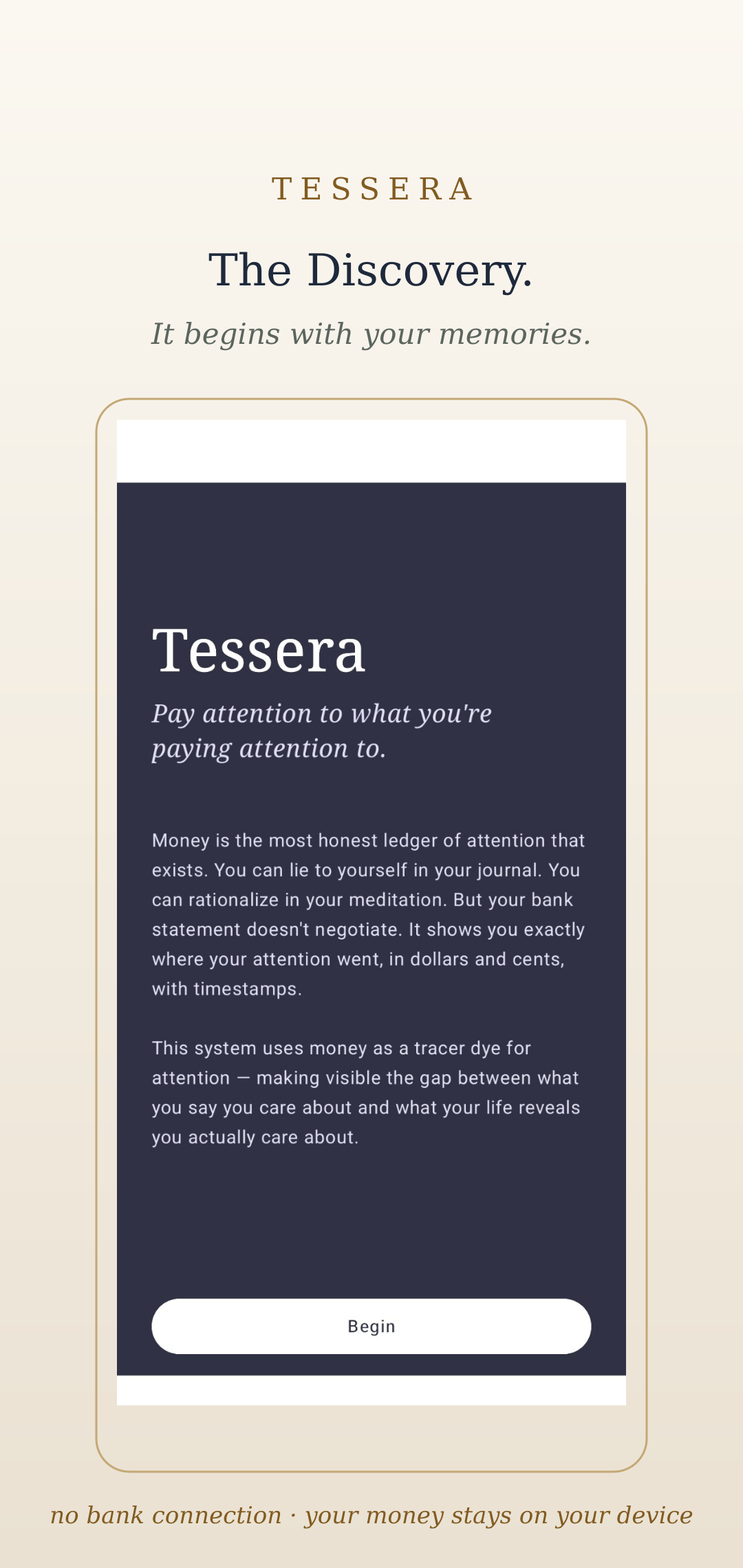
Pay attention to what you’re paying attention to.
The Philosophy
Money is the most honest ledger of attention that exists
You can lie to yourself in your journal. You can rationalize in your meditation. But your bank statement doesn’t negotiate — it shows you exactly where your attention went, in dollars and cents, with timestamps. Tessera uses money as a tracer dye for attention: not to track spending, but to make visible the gap between what you say you care about and what your life reveals you actually care about.
Why: every budgeting app asks “where did the money go?” Tessera asks “where did you go?” The money is the instrument; the attention is the subject.
The Discovery
Eight steps to your financial identity
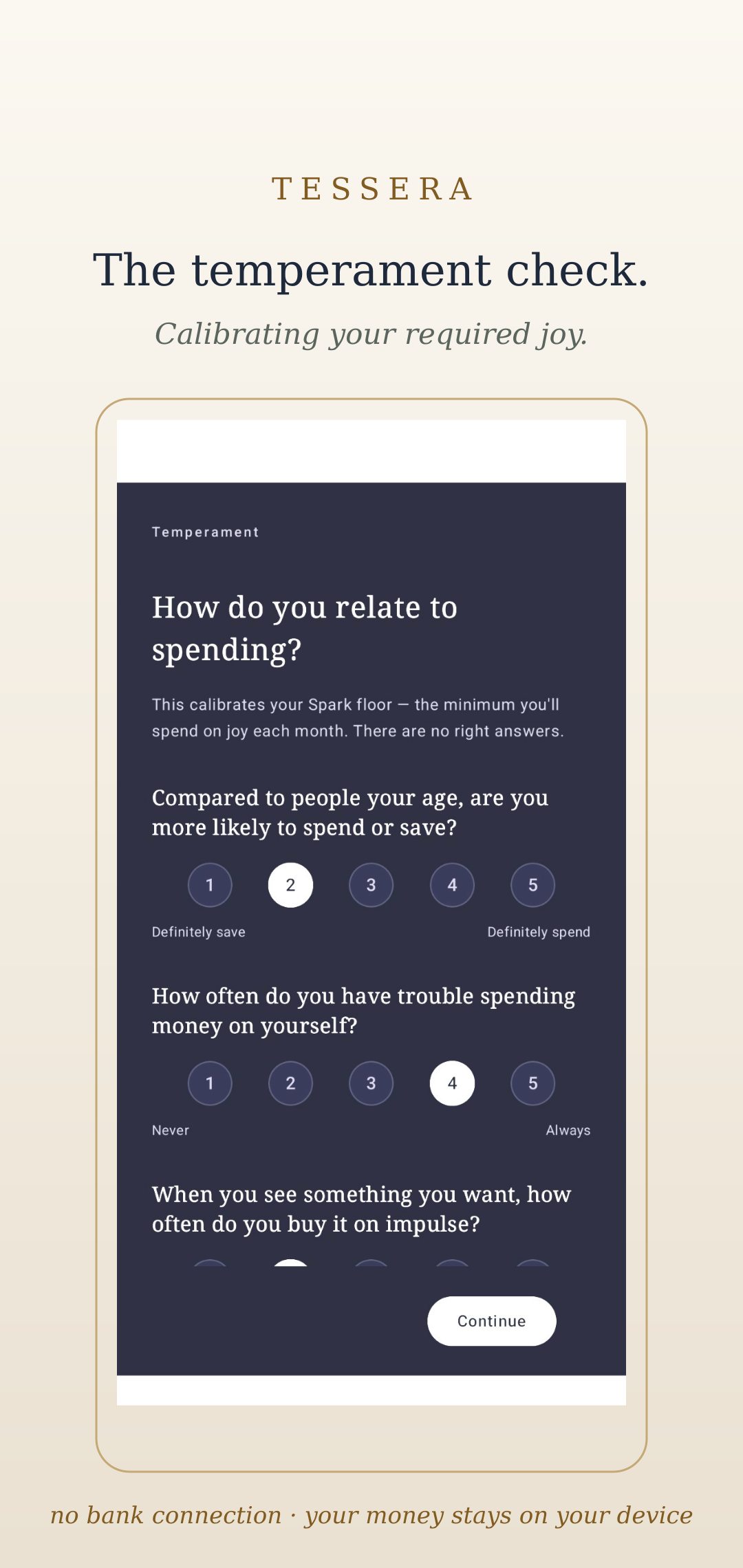
Tessera doesn’t start with categories or a bank connection. It starts with three questions about your lived experience of money: the times you felt genuinely satisfied after spending, the purchases you regretted, the spending you envy. From your answers, you distill your values — three to five names that will tag every dollar. Then a four-question temperament check calibrates your Spark floor, your income sets the scale, and your allocation appears.
Why: values discovered from evidence (your actual memories) are truer than values chosen from a list. The envy question is the secret — envy points at values you’re starving. If you envy a friend’s travel budget, the value might be Adventure.
Step 1–3 (Discovery): Write in sensory detail. Don’t analyze — just recall.
Step 4 (Values): Choose 3–5 from the list, or name your own. These names will follow every dollar.
Step 5 (Temperament): Four honest questions. No right answers — this calibrates your required joy.
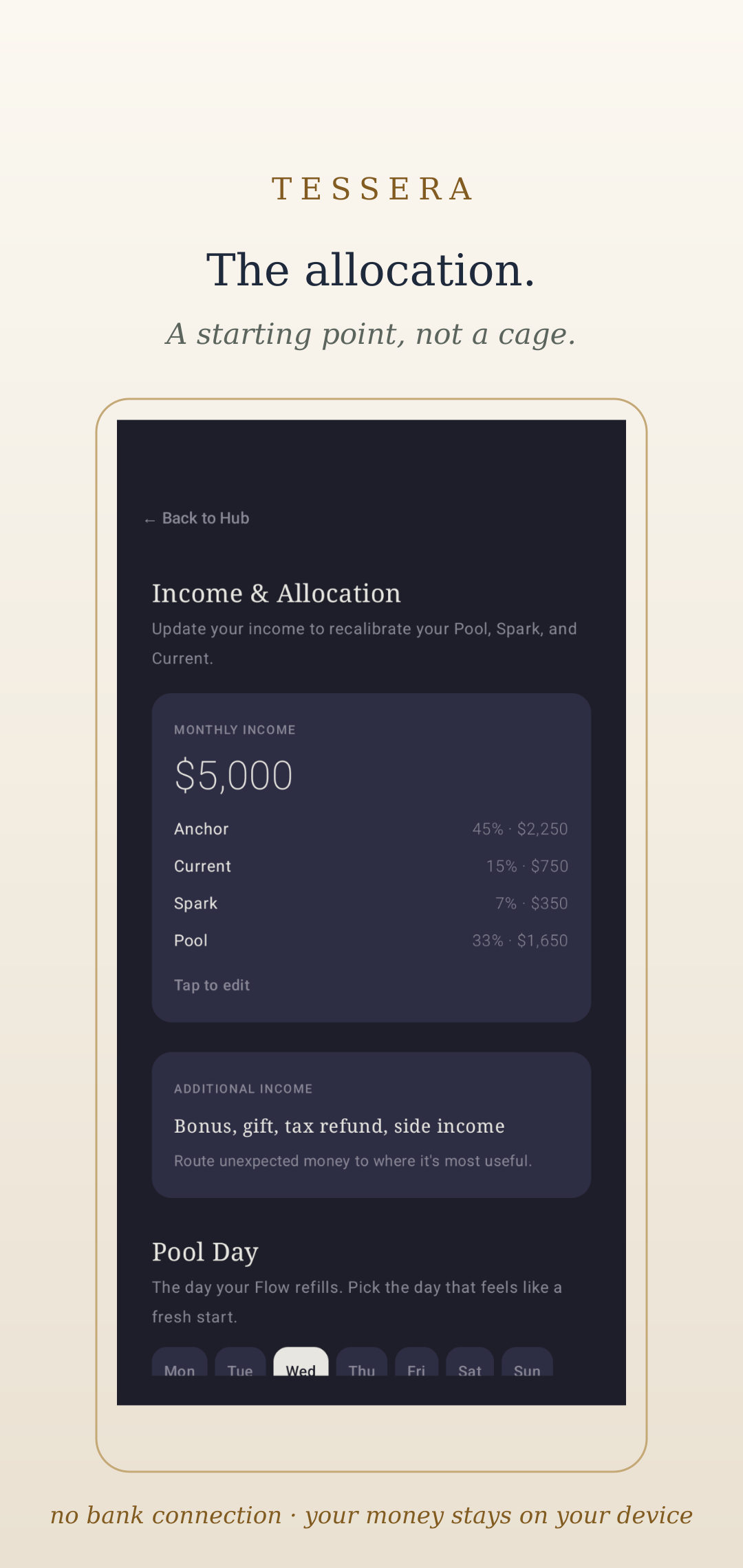
Step 6–7 (Income): Monthly take-home. The system calculates your entire allocation.
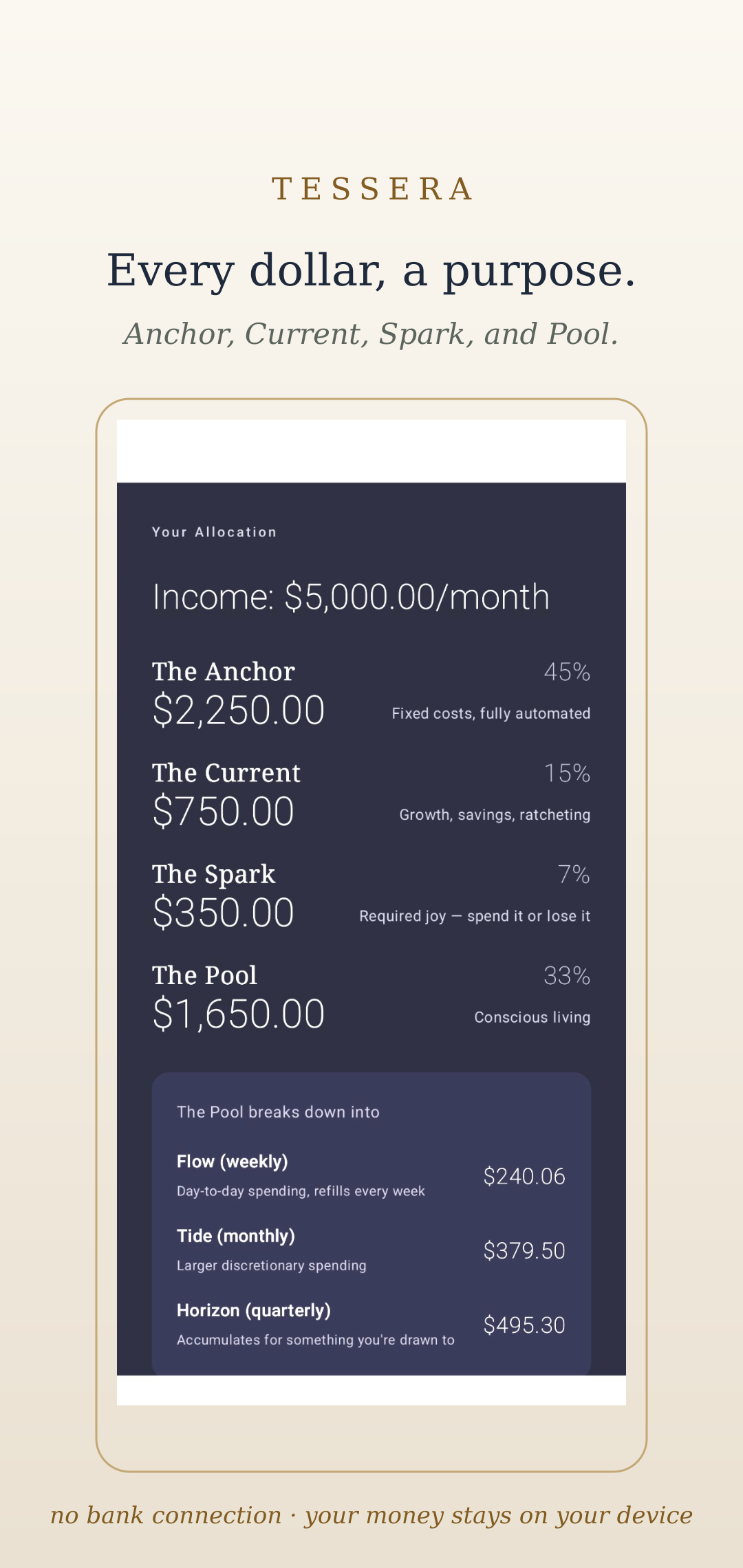
Step 8 (Allocation): Your Anchor, Current, Spark, and Pool — a starting point, not a cage. Adjust anything later.
The Hub
Flow, Tide, and Spark — at a glance
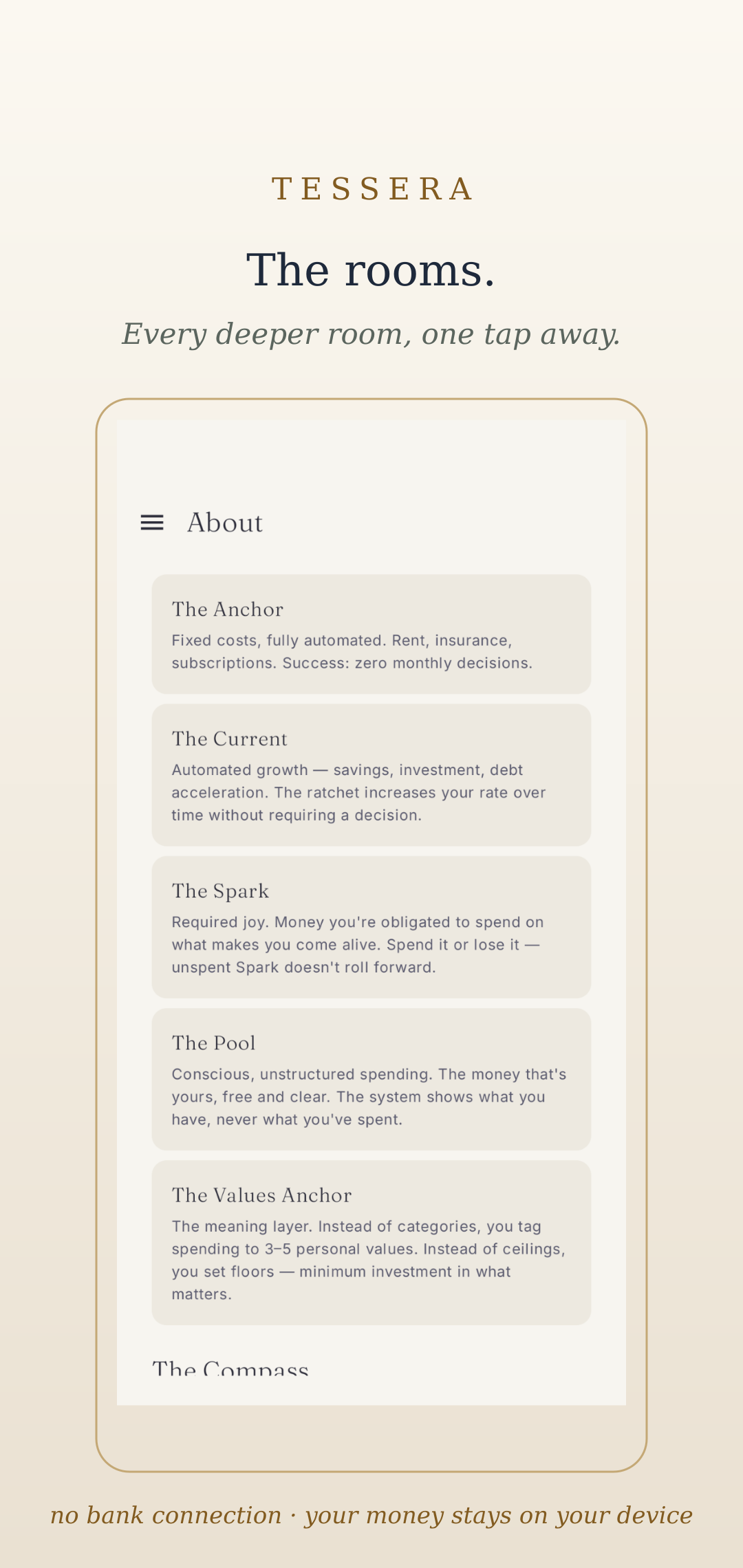
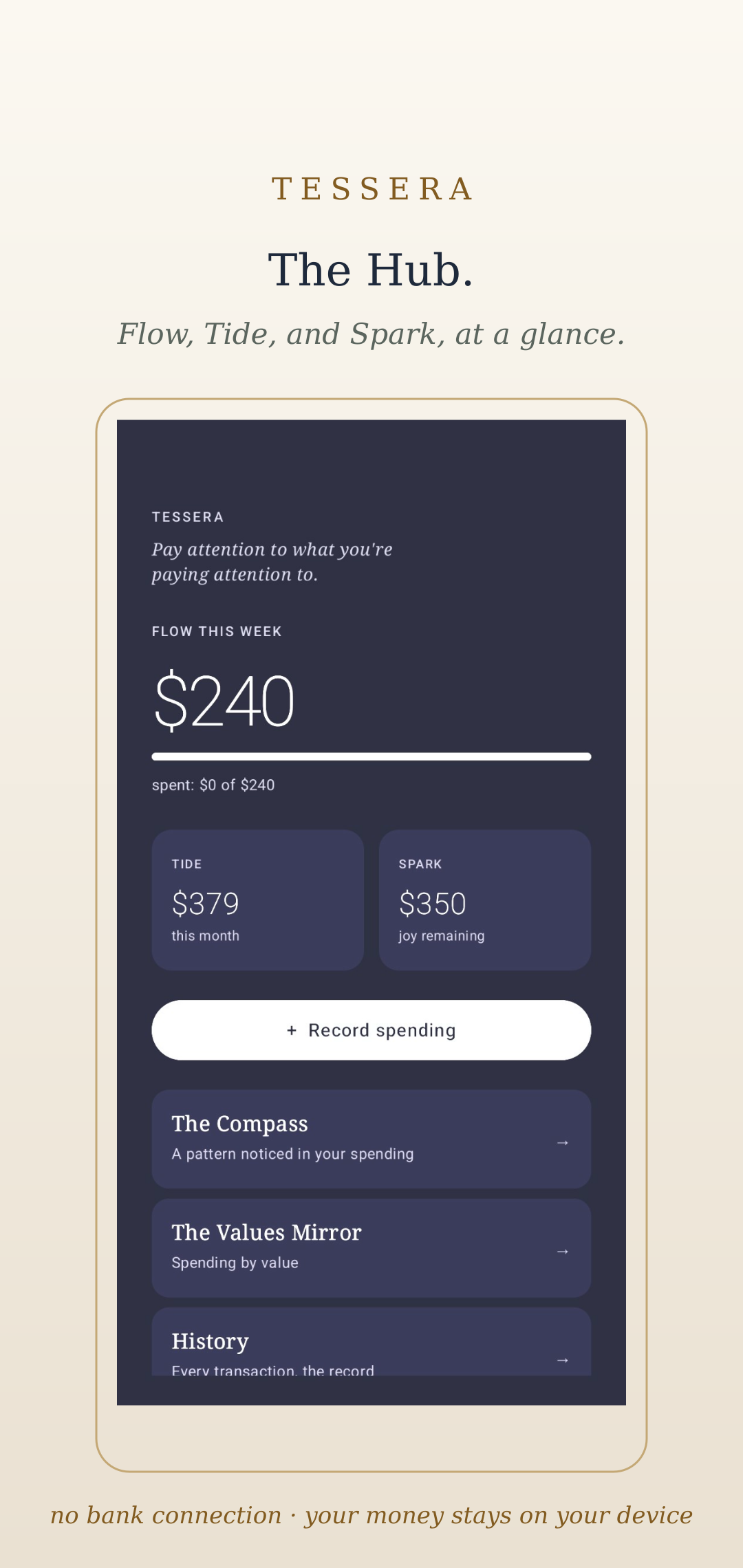
The Hub is Tessera’s home. Your weekly Flow shows at the top — how much remains for day-to-day spending this week, with a progress bar. Below: Tide (your monthly discretionary pool) and Spark (your remaining required joy). One big button records new spending. Every deeper room is one tap away.
Why: the week is the natural unit of spending attention. A monthly budget is too far away to feel; a weekly Flow refills often enough to matter, often enough to practice.
Daily check: Open the app. See your Flow. Know where you stand.
Recording Spending
One number, one moment of attention
Tapping “Record spending” opens the daily act: enter the amount, optionally describe it, tag it to a value, rate its fulfillment (1–5), and mark it as Spark spending if it was joy. Save. The note joins your history.
Why: the moment of recording is the moment of noticing. “Was this $14 lunch about Vitality or just habit?” The tagging is the practice — it forces one honest question per purchase. The fulfillment rating builds your personal joy data over time.
Amount: What you spent. Required.
Description: Optional — a word or two.
Value tag: Which of your values this purchase served. Optional but powerful.
Fulfillment: Shown for purchases over $20 or tagged ones. One honest number, 1–5.
Spark: Toggle if this was joy spending — it counts against your Spark floor.
The Values Mirror
Spending by value — the honest reflection
The Mirror shows your pool spending grouped by value: colored bars sized by amount, fulfillment dots underneath, the percentage of pool for each. Untagged spending shows separately — the attention you haven’t accounted for yet.
Why: this is the “mirror” — it shows you what your money says about what you care about. If Connection is your deepest value but shows the smallest bar, the mirror holds that truth gently, without judgment. The drift prompt names it when the gap grows.
Read it: Longer bar = more attention. More dots = more fulfillment data. The mirror fills in as you tag spending.
The Compass
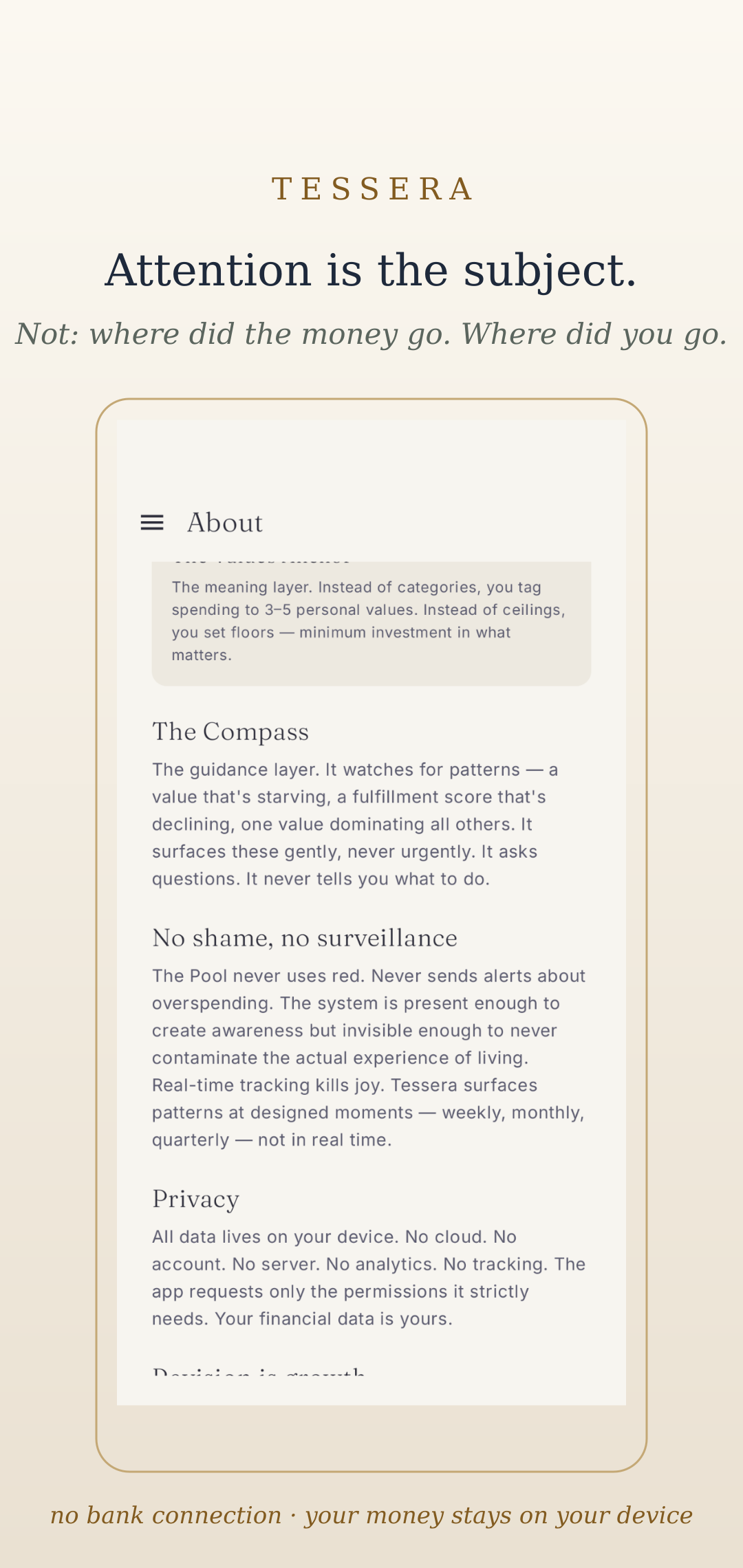
A pattern noticed — gently, never urgently
The Compass observes your spending patterns and surfaces them as gentle observations: “Your spending tells a story about Adventure. $340 across your recent transactions.” A question follows — “Is this where you want your attention?” — with honest response options. Your responses are kept, building a record of your relationship with your patterns.
Why: awareness without shame. The Compass never says you spent “too much” — it shows you where your attention went and asks if that’s where you want it. Patterns you confirm become the practice; patterns you question become the shift.
Visit: The Compass is quiet until patterns exist — a few weeks of tagged spending. Then it speaks, softly.
The Pools
Flow, Tide, and Horizon — conscious living
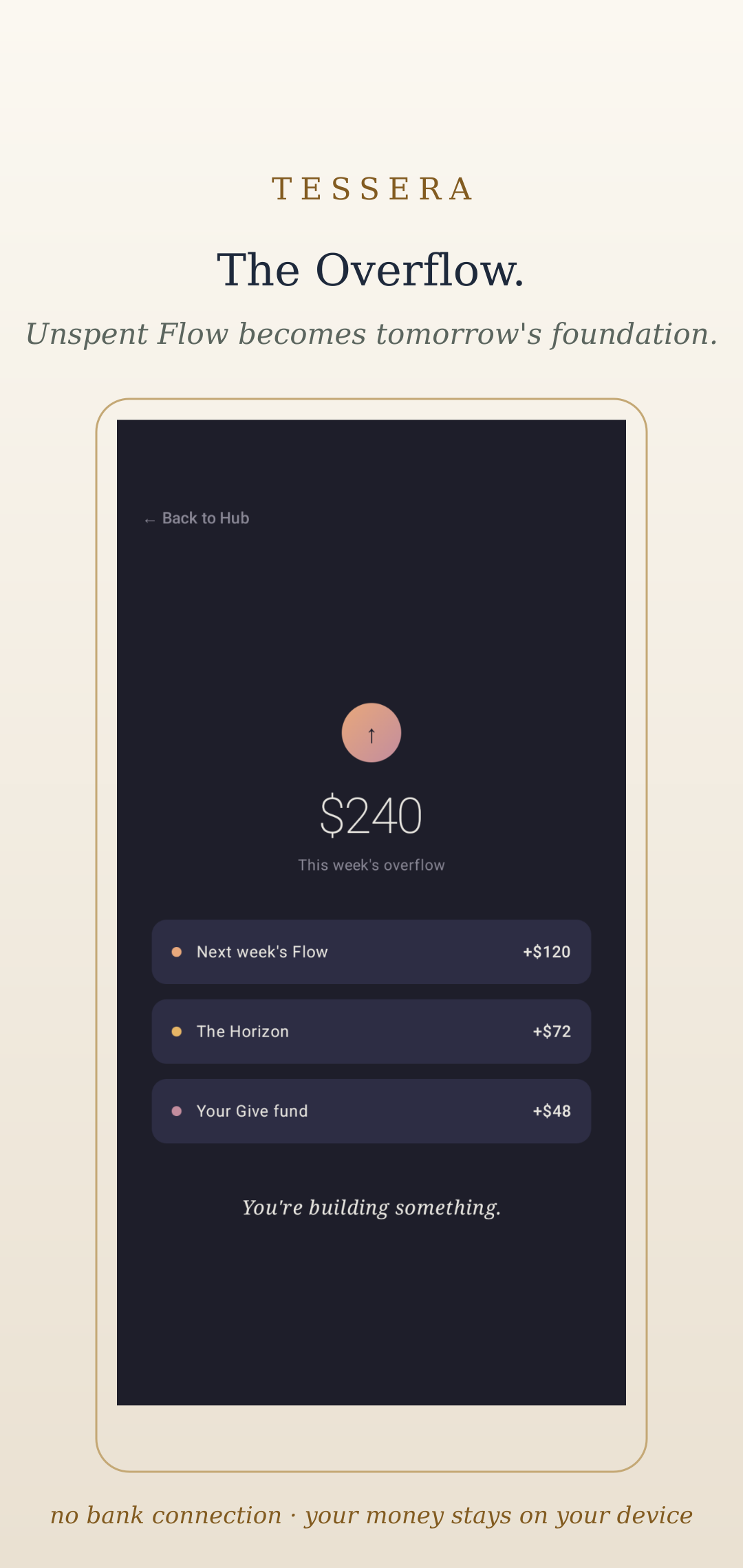
Your Pool (the conscious-living portion of income) breaks into three: Flow refills weekly for day-to-day spending; Tide refills monthly for larger discretionary purchases; Horizon accumulates quarterly for the thing you’re drawn toward. Unused Flow at week’s end triggers the Overflow — nothing is wasted, nothing carries over unchanged.
Why: different spending needs different rhythms. Weekly Flow stays honest; monthly Tide handles the bigger swings; Horizon lets you save toward desire without a separate savings account. And the Overflow means unspent Flow becomes tomorrow’s foundation, not today’s guilt.
The Spark
Required joy — spend it or lose it
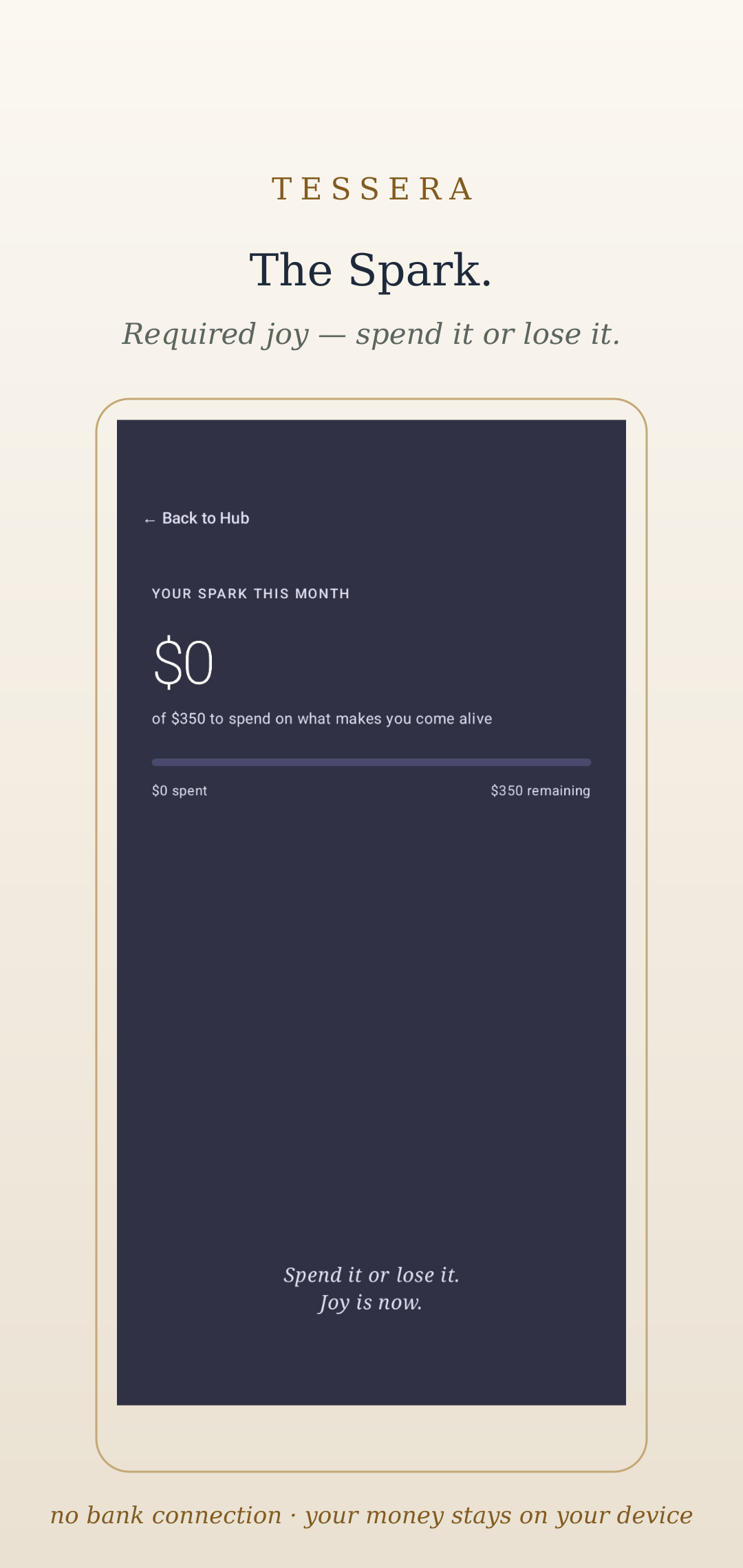
Your Spark is the monthly floor of joy spending, calibrated by your temperament. It resets every month: what you don’t spend is gone. No rollover, no banking it. Joy is now.
Why: tightwads don’t overspend — they under-live. The Spark floor forces a minimum of aliveness into your budget. For the frugal temperament, it’s higher (10% of income) because the resistance is stronger. The app tracks your Spark spending and shows what your joy activated — which values it fed.
Use it: Mark joy purchases as Spark when recording. Watch the bar fill. Don’t finish the month with it empty.
The Anchor
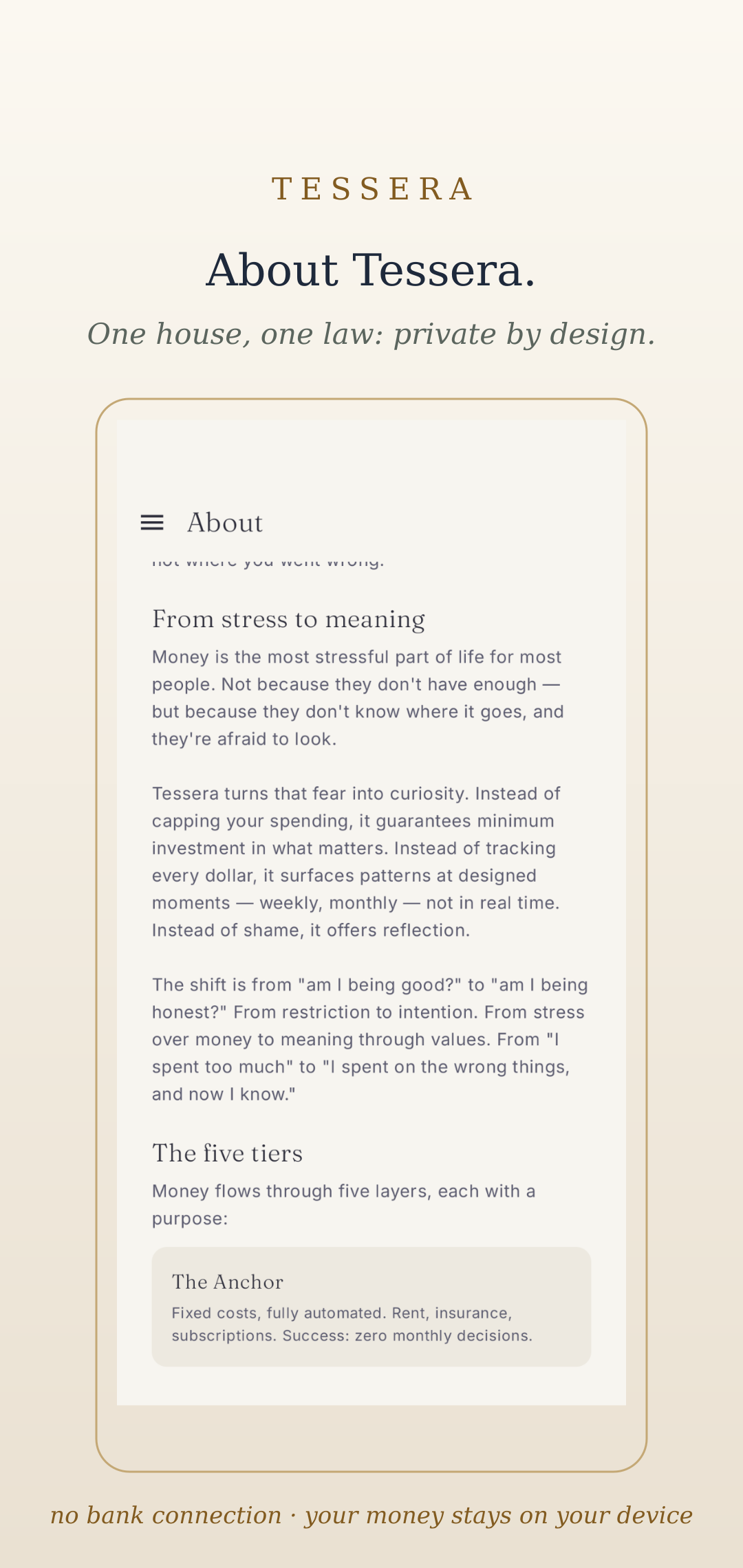
Fixed costs, fully automated
Your Anchor holds the fixed expenses: rent, insurance, subscriptions. Enter each with its monthly amount and category. The Anchor shows your total fixed cost, the percentage of income it consumes, and a warning if it exceeds 55%. A buffer target (one month of Anchor expenses) sits beneath — the system’s shock absorber.
Why: fixed costs are the structural part of your finances — they can’t be fixed by willpower, only by structure. Seeing the Anchor’s true percentage is the first honest look. Over 55% isn’t a spending problem — it’s a structural one, and the app says so.
Add expenses: Name, amount, category, hard or soft fixed. Tap any expense to edit or delete.
Audit: The subscription question at the bottom: when did you last use each? Honest answers here free up Anchor space.
The Current
Automated growth, ratcheting upward
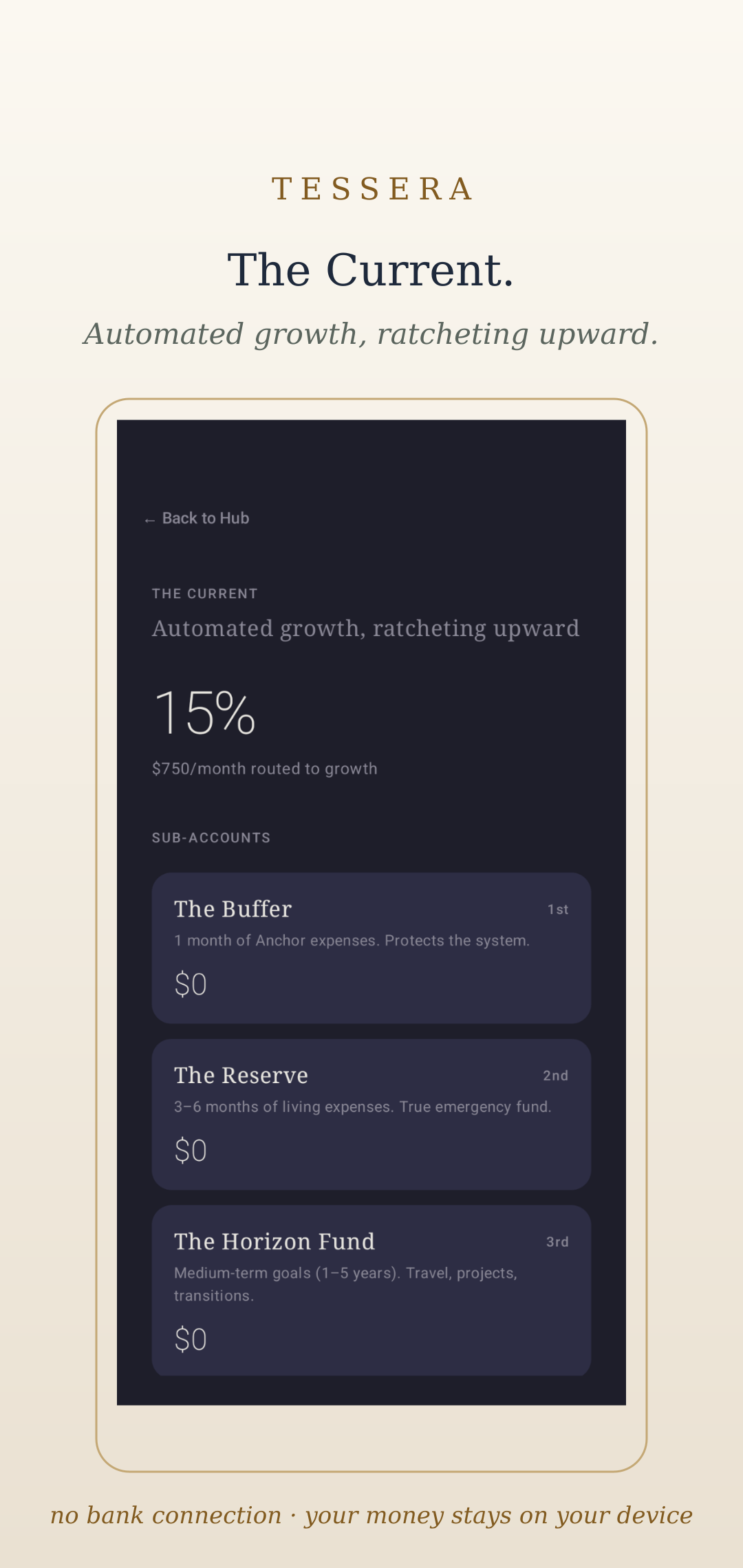
The Current is your savings layer: a percentage of income routed to four sub-accounts in priority order — the Buffer (one month of protection), the Reserve (3–6 months of true emergency fund), the Horizon Fund (1–5 year goals), and the Deep Future (retirement, investment, debt acceleration). The Ratchet increases your savings rate by 1% automatically every twelve months, and routes 50% of any raise here. You can pause it. You cannot reverse it.
Why: savings that require willpower fail. The Ratchet makes growth automatic and one-directional — like a ratchet wrench, it only turns one way. The sub-accounts give every dollar a purpose, in priority order, so you always know what this month’s saving is for.
The Overflow
Where last week’s Flow goes — the 50/30/20
When the week ends with unspent Flow, the Overflow splits it: 50% to next week’s Flow, 30% to your Horizon fund, 20% to your Give balance. The app celebrates the overflow — it means you spent less than you allotted.
Why: unspent money shouldn’t pool into guilt or evaporate into drift. The split is designed: half keeps the weekly rhythm funded, nearly a third builds your future, a fifth feeds your generosity — because giving is one of the most reliably fulfilling uses of money.
The Joy Audit
Three questions, monthly
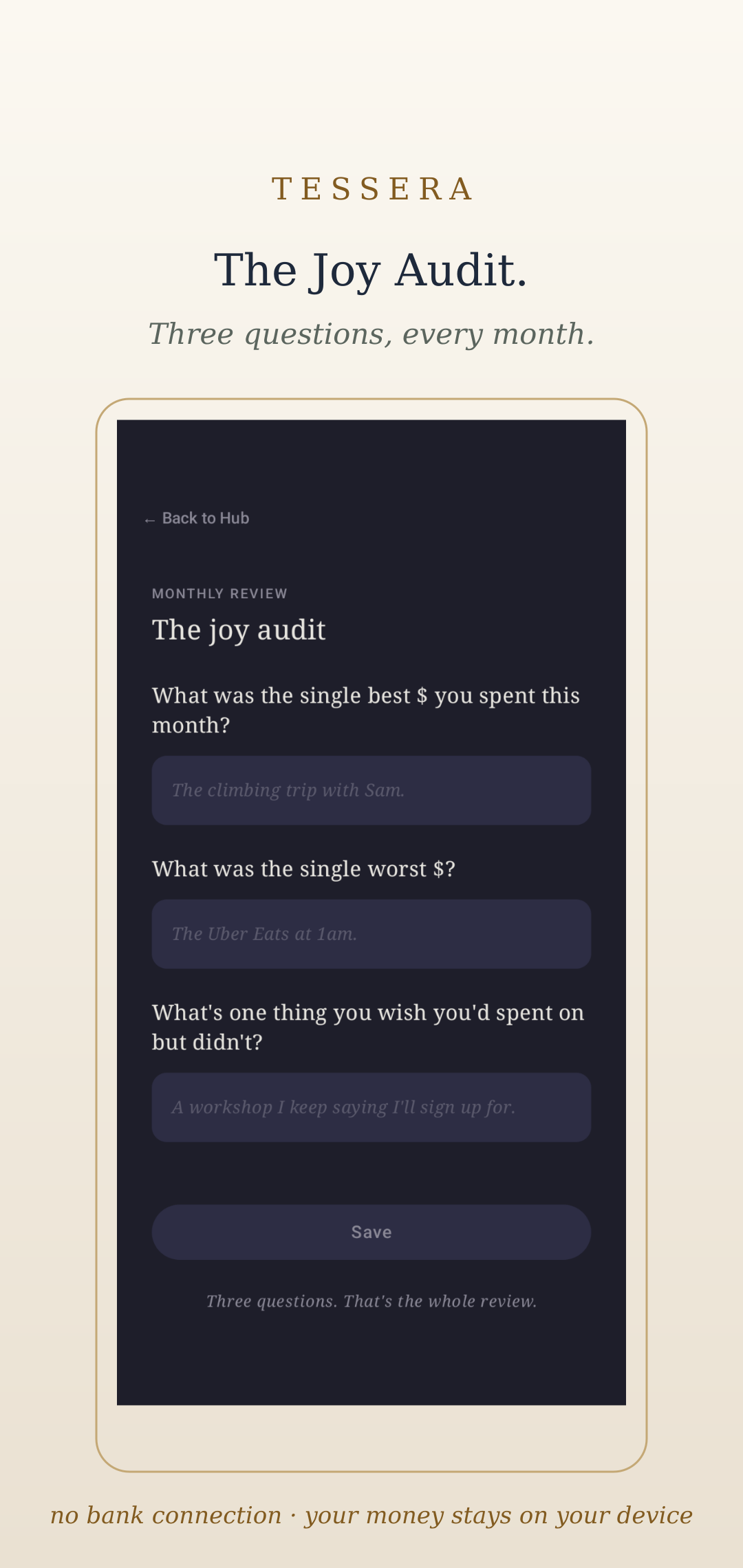
Every month, the Joy Audit asks: what was the single best dollar you spent? The single worst? What do you wish you’d spent on but didn’t? Three answers, saved as your monthly review.
Why: the audit closes the loop between attention and memory. Your tagged transactions show the pattern; the audit shows what the pattern felt like. Over months, your best-and-worst answers become your personal spending wisdom — evidence-based, yours alone.
Monthly: Three text answers. Two minutes. Your reviews accumulate in the Library of your history.
History
Every transaction, the record of attention
Every recorded transaction appears in History, most recent first. Tap any entry to expand it: re-tag its value, change its fulfillment rating, or delete it. The record is yours to correct — the truth matters more than the original entry.
Why: the record lets the Compass and the Mirror work — they read this history. But the record also serves you directly: a searchable, editable ledger of where your attention actually went.
Your Values
The names you tag to — alive, dormant, or new
Your values are the tags every dollar carries. Manage them here: add new ones (up to five — fewer is stronger), release any to dormant (all past data stays intact), or reactivate a dormant value when it calls again. Each value carries a color from the spectrum — the only saturated colors in the app.
Why: values change. The one that mattered last year may have quietly finished its work. Releasing it to dormant (instead of deleting) honors that history while making room for what’s alive now.
Privacy
No bank connection. No servers. No third parties.
Tessera never asks for your bank credentials. You enter what you spent — one number, one moment of attention. Everything lives on your device: transactions, values, reviews, your entire financial identity. No server-side database. No analytics. No bank integration handing your data to a third-party aggregator.
Why: your spending history is your attention made visible — among the most intimate data you produce. Connecting your bank means handing it to an aggregator (Mint, YNAB, Copilot all do this). Tessera’s architecture makes that impossible: there is nowhere for the data to go. We can’t read it even if we wanted to. That’s not a policy — it’s the design.